February intake
Classes begin February
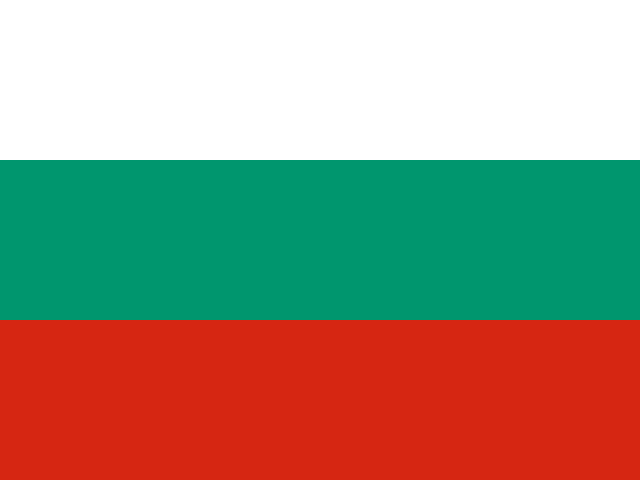
Bulgaria is a study destination in Southeast Europe. Its capital is Sofia. Bulgarian is official. Costs are quoted in Bulgarian lev (лв).
Southeast Europe · Sofia · Bulgarian
5-minute assessmentFree, no obligationNo sign-up to start
01 Overview
Bulgaria sits in Southeast Europe, with Sofia as its capital, and offers a mature, well-funded university system.
It is a member of the European Union, so degrees carry recognition across the bloc and Erasmus+ mobility is open to you once you are enrolled.
Bulgarian is the official language, and that is the first thing to check against any programme you shortlist. English-taught degrees exist here, but they are a subset of the catalogue rather than the default, and the ones that exist concentrate at master's level.
On cost, Bulgaria sits in the high-income group, which shapes your budget more than any single university does: tuition runs 6,000 to 25,000 USD a year; living costs run 900 to 1,800 USD a month. UNESCO counted 15,438 international students here in 2024.
02 Study paths
Pick the route closest to where you are today. Entry rules, timelines and costs in Bulgaria all change with it.
Undergraduate study, usually beginning straight after school.
What you need to enter
Durations and entry rules are typical for the level. Each programme sets its own, so check before you shortlist.
Postgraduate study after a bachelor's degree, taught or research-led, often ending in a thesis.
What you need to enter
Durations and entry rules are typical for the level. Each programme sets its own, so check before you shortlist.
A postgraduate business degree, usually asking for work experience alongside a first degree.
What you need to enter
Durations and entry rules are typical for the level. Each programme sets its own, so check before you shortlist.
Doctoral research under supervision, leading to a thesis.
What you need to enter
Durations and entry rules are typical for the level. Each programme sets its own, so check before you shortlist.
03 Universities
37 universities profiled with tuition, entry requirements and deadlines.
04 Intakes
Bulgaria runs 2 intakes a year. Applications open well ahead of the month teaching begins.
Classes begin February
Classes begin October
05 Cost
Indicative ranges for international students, in USD. Treat every figure here as a starting point, not a quote.
06 Language
Requirements are set per programme. Use these as the usual range, and confirm the exact score with each university.
| Test | Requirement | Usual minimum |
|---|---|---|
| IELTS Academic | Varies by programme | 6 |
| TOEFL iBT | Varies by programme | Set by programme |
| PTE Academic | Varies by programme | Set by programme |
| Duolingo English Test | Varies by programme | Set by programme |
07 Work & visa
The pathway from your first semester to work after graduation, and the visa conditions attached to each stage.
Visa overview
Student visa
08 By the numbers
The figures that shape a decision, taken from what is published on Universta.
University profiles Universta holds for Bulgaria, each with its own courses, fees and entry requirements. It is what we cover, not a count of every institution in the country.
The country's own published figure, recorded by an editor rather than counted by Universta. It says how used to international students the system is -- support services, English-taught provision, visa processing -- rather than anything about your own chances.
The lowest international rate published for Bulgaria; the range runs to лв25,000. Your own figure sits somewhere between the two and depends on the university and the programme, not on the destination alone.
February and October. Applications usually open several months ahead of each one, so the intake you are aiming at decides when your documents have to be ready -- not when the course starts.
09
The figures here are an indicative band for the high-income group Bulgaria belongs to, quoted in US dollars. They are a planning range for building a shortlist, not a quote: confirm the actual number with the university before you commit to anything.
10
Bulgaria is in the Schengen area, so study longer than 90 days runs on a national long-stay visa rather than a short Schengen one. You apply at the mission that covers your country, and convert it into a residence permit after arrival.
Rules change without much notice. Confirm the current requirement with the Bulgaria mission in your country before you book travel or pay anything.
11
Bulgaria sits in Southeast Europe, with Sofia as its capital, and offers a mature, well-funded university system. It is a member of the European Union, so degrees carry recognition across the bloc and Erasmus+ mobility is open to you once you are enrolled.
Bulgarian is the official language, and that is the first thing to check against any programme you shortlist. English-taught degrees exist here, but they are a subset of the catalogue rather than the default, and the ones that exist concentrate at master's level.
On cost, Bulgaria sits in the high-income group, which shapes your budget more than any single university does: tuition runs 6,000 to 25,000 USD a year; living costs run 900 to 1,800 USD a month. UNESCO counted 15,438 international students here in 2024.
12
The sequence below is the one that works for Bulgaria. Dates move, the order does not.
13 Questions
The questions students ask before they commit. If yours is not here, the assessment is the fastest way to a specific answer.
Next step
Tell us about your academic profile, goals and budget, and a counsellor will match it against live programmes.
Free assessmentPersonalised guidanceNo obligation
Explore other destinations
Put both against your own profile instead of against each other.